It’s raining again.
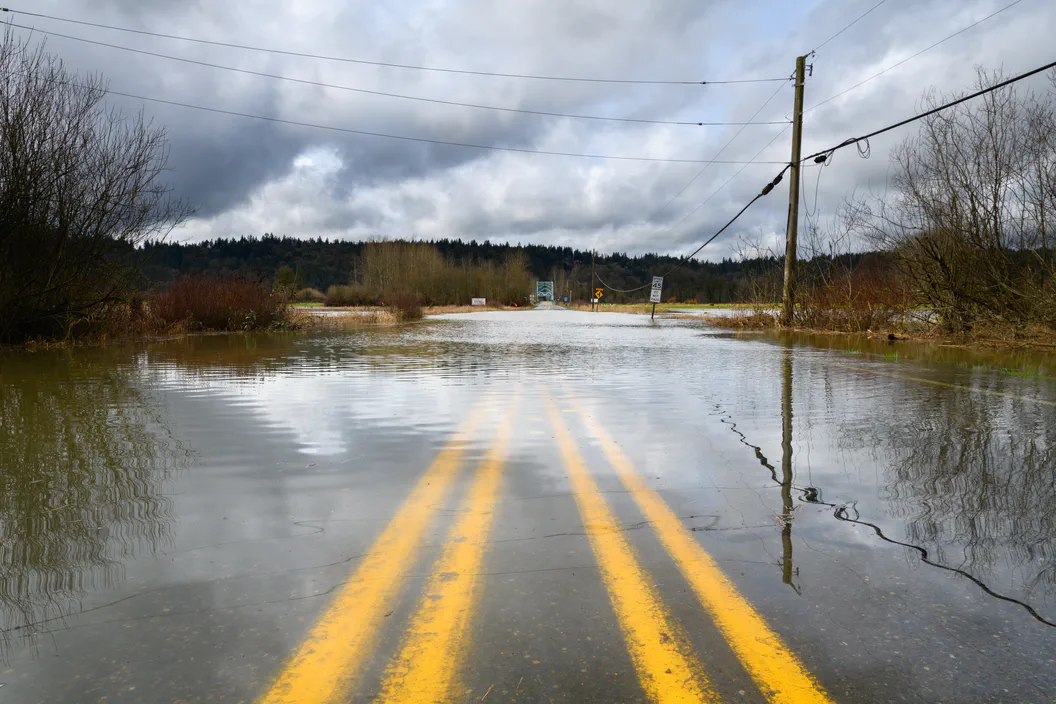
Yesterday was Monday, and NE124th Street (the southern route across the valley) finally reopened after a week underwater. There is still water on the road and we all know that means it could be only temporary. One by one, every road in and out of Duvall closed during this last flood, all except the Woodinville-Duvall Road access, where cars backed up for close to two hours just to get home. Did you know that if we hadn’t had flooding in December, this flood would be the worst in the last 10 years? A friend took his kids to their sports practices in Snohomish last week and described water creeping up within inches of the lane lines the whole way. We talked about it: what if someone breaks down? Do they pull over into the water? And if an emergency vehicle needs to get through miles of backed-up two-lane road, do we expect elderly drivers to pull their cars into the wet shoulder?
Muddy floodwaters swirl along the valley, pushing up over the riverbanks and into parks and trails and roadways. The water rises slowly, and by its presence slowly separates people into isolation. Parents can’t get home to their babies. Support for elderly neighbors gets suspended. Grocery prices spike because we’re cut off and local demand jumps. The mayor’s office posts warnings on social media: Stay out of the water. The current is strong, the water is cold, and the edges are unstable. All of this is true. None of it is news to us.
Here is what I keep thinking about: it doesn’t have to be this way. These roads, their condition, their vulnerability, their insufficiency, are not as they have to be. They are the result of choices made by people with budgets and priorities and a mental map of the county in which Duvall sits somewhere near the edge. Not the center. The edge. And at the edge, the money runs thin before it gets to you, and the squeaky wheels are somewhere else, and the overwhelming weight of bigger problems means that small, peripheral communities wait. And wait. And wait.
We at SFCC have been watching this dynamic play out for years in another form entirely: the effort to bring a pool and community center to Duvall. It has been tried before. More than once. Each time it has run into the same quiet wall, not a loud refusal, but an absence. An unlistening ear. The overwhelm at the top that makes small communities effectively invisible.
This is the thing about living at the edge of a county, at the end of a road that floods: you learn, eventually, that no one is coming to solve it for you. That is a hard and clarifying thing to know. It is also, if you let it be, a galvanizing one.
The flood and the pool are not separate problems. They are the same problem expressed in different ways. Both are about what happens when a community is too far from the center to be seen clearly, when the connection, the access, the infrastructure that everyone else takes for granted is either chronically underfunded or suddenly underwater. The flood isolates us in emergencies. The absence of a community gathering place isolates us the rest of the time, slowly, quietly, especially the elderly, the kids without transportation, the families for whom a 45-minute drive to a pool or a rec center is not a reasonable option.
We have been asking for help from the outside for a long time. We are still asking, and we should keep asking. But we are also, at the same time, going to build this ourselves.
That is why we are launching a community fundraising campaign for the Duvall pool and community center, and we are asking for your help.
Here is what we are dreaming of building: a lap pool for fitness and competition, a warm water therapy pool for healing and rehabilitation, a resistance pool for play and low-impact exercise, and a zero-entry family area where little ones can splash and parents can breathe. A multipurpose sports court. Private rooms for treatment, meetings, and rentals. Spaces to lounge and linger, a real lobby, hallways where you might run into a neighbor. Classrooms. And an outdoor deck where you can throw a birthday party, spread out a picnic, and look up at the mountains that remind you exactly why you chose to live here.
We are not asking for luxury. This is what other communities have and take for granted. This is what it looks like to stop being invisible.
Right now we are in Phase 0, the unglamorous, necessary work of laying the foundation for the larger, multi-million dollar phases ahead. That means costs are real and immediate, even if the building isn’t yet. Every dollar you give now helps us get to the table, stay in the conversation, and prove that this community is serious.
Would you consider donating toward this goal? Would you give $25? $50? $100? Or more? We know the economy is hard right now and that any gift is something precious, and we mean that. We refuse to be silent, to accept isolation, to give in to being invisible.
Help us build toward something good. Link to donate