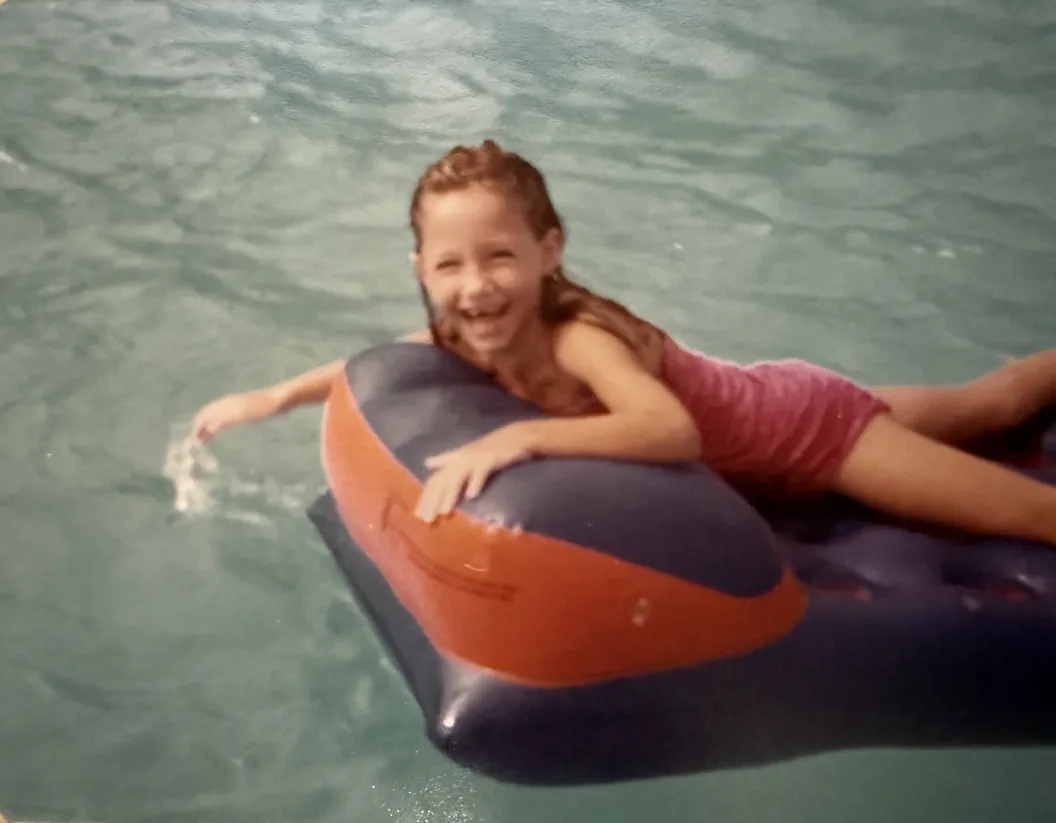
My dad taught me how to swim when I was quite little. Going to the pool was just a “thing” we did for fun as a family in the summer. He would hold me in the water and gently swoosh me around. I loved it. And it bonded us. He played games with me to get me comfortable with putting my head under the water. He taught me to float. I knew that this would be how I could save my own life if I ever accidentally fell in the water. Just lay on my back, tilt my nose towards the sky, and relax, keeping my “butt up.” Eventually, he taught me some strokes. Mainly he taught me freestyle and a little backstroke. He tried to teach me breaststroke but it didn’t stick.
When I was six, I had an asthma attack within 24 hours of moving to Houston Texas in the 1980s when the air was filled with smog. When I was 19, my pulmonologist told me I had to start exercising – I shouldn’t be out of breath just from going up a few flights of stairs to get to my college dorm room on the 4th floor. Two months later, I moved to Puebla Mexico. There was an outdoor pool within a 10 minute walk from my dorm, so I started going there.
The pool was empty when I went first thing in the morning and the air was still cold from the sunless night. So the lifeguard would watch me slowly swim 25 meters and pause for a full minute at the end of the pool to catch my breath. A full lap took four minutes. I swam 6 laps a day.
Eventually, after watching for two weeks, the lifeguard offered some guidance. Over the 10 months that I lived in Mexico and swam every morning, that lifeguard tuned my stroke and encouraged me. By the end of the schoolyear, I could swim thirty 50-meter laps. The lifeguard quintupled the distance I could achieve in 30 minutes.
When I returned to Texas A&M University #TAMU for my junior year, I joined the US Masters Team (USMS), a group of swimmers of any ability and any age “from 18-99” that pay a coach to lead a structured 75 minute swim practice a few times a week. These clubs are all over the USA. I started in the “slow lane.” That first coach must have been so patient with me. Close your fingers. Tilt your hand. Imagine you’re holding an apple between your chin and your chest. By the time I graduated from college two years later, I was swimming sixty 50-meter laps in an hour. I was surprised when a friend called me an athlete – I had never thought of myself that way.
Swimming became my reprieve. I thought it was for managing the asthma and keeping my body fit. Thirty years later, when I no longer had access to a pool in my region, I realized it was actually what regulated my race-car-brain-with-no-brakes. I had to focus on breathing every third stroke. The sound of the water moving came to the forefront and muffled all of the noise so I could just listen to the sound of my breath. Thirty minutes of moving meditation.
I moved a lot with General Electric (#GE) during the first half of my career, and there was always a pool within a 15 minute drive of my home or office. I didn’t really even need to think about the logistics of fitting a swim in before or after work. Not only that, but they all had punch cards that enabled me to swim for $5-8 per session.
After 18 months of pandemic quarantining, work-from-home became a norm across the world. Our family decided to leave the city, like many others before us. I started driving 27 minutes once a week just to get to the closest pool. And I paid over $100 a month to do it because the closest pool was by membership only. A 30 minute swim became a 2.5 hour endeavor. It was untenable.
So in winter 2025, when someone in our community said – has anyone ever thought about building a pool in our community, I raised my hand. And we started a small group of folks who also wanted to have a place to swim laps, a place their kid could safely learn to swim, or a place where they could move their bodies – even with physical challenges or impairments.
Just a few months later, my family and I joined our friends at their gym pool with tons of lifeguards, and signs educating that drowning happens quickly and parents should keep children who are not savvy swimmers within arms length.
My kids were in line with the other kids to hop from lily pad to lily pad, some of them hanging from the monkey rings. I watched from the edge of pool with my feet dangling in the water. So when a 2nd grader sat on the first lily pad, I watched them try to reach the second one. They couldn’t reach it. They were kind of comfortable in the water, and I could tell that this kiddo had had at least a few swim lessons. They slipped into the water and reached for the second lily pad. Tried to grip it, but couldn’t hold on. Within a few seconds, I could see that this child was slowly, quietly sinking. And it hit me – they need help. I dove in and came up under the child to push them above the water and carried them the two or three feet to the wall. By the time I got there, the lifeguard that had been behind me surveying this area and the area next to it was at my side. The child coughed up water and then vomited. The lifeguard looked for signs of slow drowning. The parents ran over. The lead lifeguard came over and reviewed the signs of slow drowning and what they should watch for over the next 24 hours.
Signs of secondary/dry drowning (can appear hours after water exposure):
- Persistent coughing that doesn’t stop
- Difficulty breathing or rapid/labored breathing
- Chest pain or tightness
- Unusual fatigue or extreme tiredness after swimming
- Behavior changes — irritability, mood swings, or confusion
- Vomiting
- Fever (in some cases)
- Bluish tint to lips or skin (cyanosis) — seek emergency care immediately
This was my turning point. I had been trained that drowning was not always loud and “splashy.” I knew that it happened quickly. But this child was underwater for maybe 5 seconds before I jumped in, and another 5 seconds before I got to them and surfaced them for air. Ten seconds. That’s it. If I had waited any longer, would that child have died? If I hadn’t been there, and the lifeguard behind me had been the only one there for this kid, would that child have died?
This child was from our community. Their parents had enrolled them for swim lessons at the same YMCA I swam at for a while – for two sessions. They didn’t continue because they weren’t able to continue the 2+ hour commitment to drive there, change, have the lesson, change back, and drive home, while also each working a full-time job. So they were planning to continue working with their kiddo whenever they could get pool time.
This is why we need a pool.
Water safety isn’t a privilege — it’s a life skill every child and adult deserves access to. Too many families in our community are giving up on swim lessons not because they don’t care, but because the barriers are simply too high: a 1,000-person waitlist on the Eastside. Midnight sign-ups just to grab a spot before 5:30am it’s already gone. A 2+ hour round trip that two working parents just can’t make work every week.
That little kid in the water was from our community. Their parents were trying. And they were running out of options — just like so many families here.
We’re building the Snoqualmie Foothills Community Collaborative because every family in this valley deserves what my dad gave me at the edge of a pool when I was small: the knowledge that they can save their own life. And a community to do it in, year-round, close to home.
If this story resonated with you, follow us at @snoqualmiefoothillscc and share it with someone who needs to hear it.